What is Generative UI? Is this the end of static screens?
A Revolution in Design: What is Generative UI? Is This the End of Static Screens?
Have you ever considered the limitations of traditional interface design (UI/UX)? All the applications and websites we have used to date were static and rigidly structured designs, pre-drawn by designers and coded by programmers. When you and your friend next to you entered the same application, you essentially saw the same buttons, the same menus, and the same flows.
However, with the integration of artificial intelligence into the design world, the cards are being reshuffled in the digital world. Introducing the next generation design paradigm: Generative UI.
What is Generative UI?
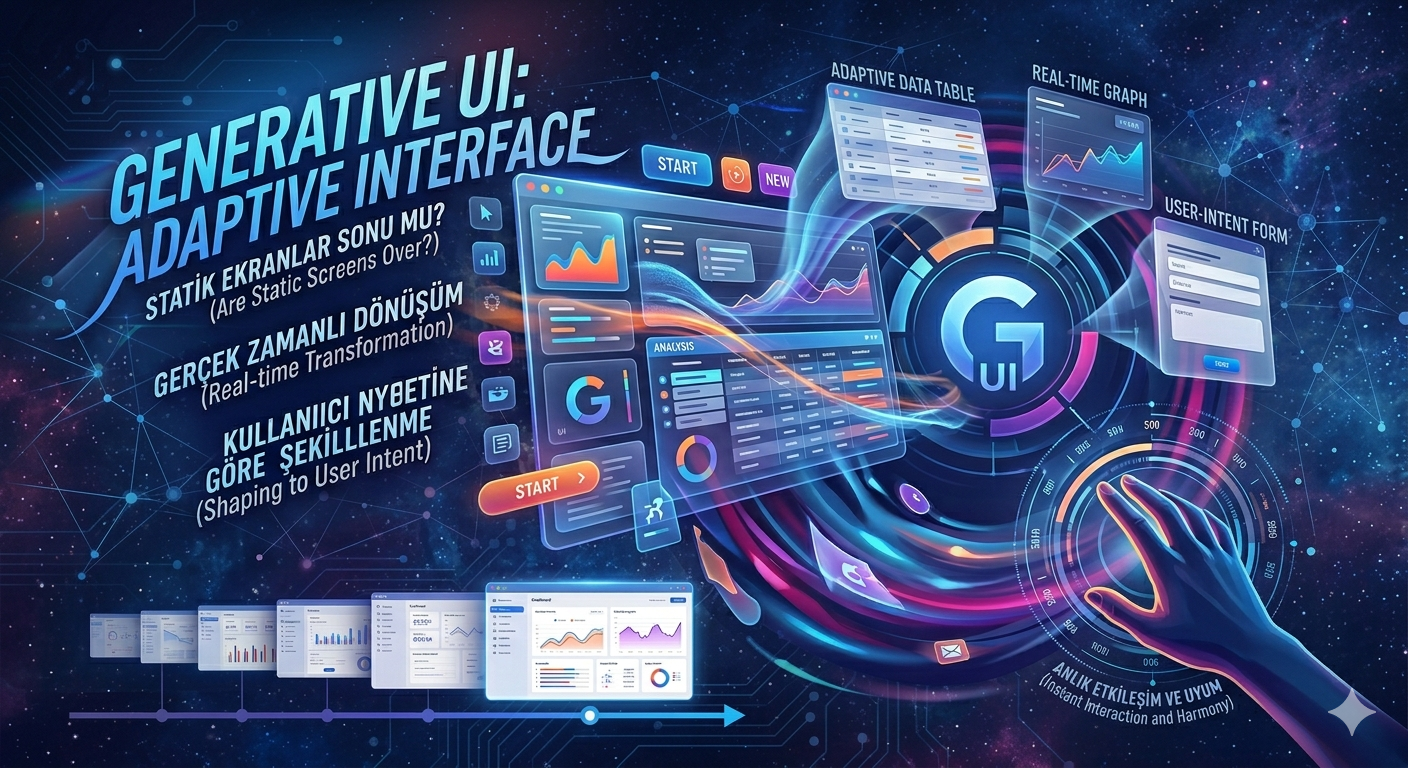
Generative UI is the creation of a user interface (UI) from scratch in real-time (instantly) by artificial intelligence, based on the user’s current intention, context, and personal needs, instead of fixed templates.
In this technology, artificial intelligence does not only generate text or images; Based on the user’s prompt (command) or behavior, it instantly codes and displays buttons, graphics, forms, and the entire page layout.
Traditional UI: “A designer draws an interface, everyone uses it.” Generative UI: “The interface adapts to the user’s needs at that moment.”
Is This the End of Static Screens?
Short answer: Yes, the era of “unchanging” screens as we know them is coming to an end. Today, when you enter an e-commerce site, you get lost among the filters trying to find the product you are looking for. In the world of Generative UI, when you tell AI, “List and compare waterproof equipment for a weekend camping trip in Bursa that fits my budget,” you don’t get a standard search results page. AI builds a completely customized interface for that comparison, including a dynamic table, a live weather widget, and a one-click purchase button. When you’re done, that screen disappears.
Why is a Big Change on the Horizon?
-
Infinite Personalization: The interface’s colors, font sizes, and components are instantly optimized based on age, eye health, technology usage habits, or current mood.
-
Frictionless UX: Instead of redirecting the user to 5 different pages to reach a goal, all The steps merge into a single dynamic flow.
-
Reduced Cognitive Load: Cluttered menus and unnecessary buttons on the screen become a thing of the past. Only the functional elements you need at that moment are displayed on the screen.
What Does This Mean for Designers and Developers?
“So, is the designers’ job over?” concern may come to mind. Actually, the opposite is true. The role of designers is evolving from “drawing screens” to “managing design systems and rules” that artificial intelligence will use.
Instead of dealing with the pixels of a single screen, designers will now build flexible, accessible, and modular component libraries (Atomic Design) that artificial intelligence can bend and shape. Using this library, artificial intelligence will generate the right button in the right place.
The Interface of the Future: Live and Fluid
Generative UI promises to bring the interaction between artificial intelligence and humans to the most natural level. In the future, applications will no longer be empty boxes that we fill; they will transform into fluid structures that breathe with us and change shape according to our needs.
We are only at the very beginning of an exciting era in digital product design where dynamic codes and artificial intelligence are replacing static pixels.